Flipping over a coffee package, “100% Arabica” has almost become a standard label, but specialty coffee beans themselves are mostly Arabica, so the actual value of this label is worth scrutinizing. Among the three major coffee species, Liberica is scarce in quantity, Robusta is mostly used for instant coffee or added in small amounts to Italian blends to increase crema and body, and what remains widely planted in other producing regions is still Arabica. The article follows genetic classification downward, sorting out the lineage divisions among members of this large family.
In earlier years, many coffee merchants labeled their products as 100% Arabica. The main coffee varieties are Arabica, Robusta, and Liberica. Brands label themselves as 100% Arabica, implying others are not, but what is the actual truth?
The specialty coffee beans you can buy are basically all Arabica!!!!!!!
Among the three types of coffee beans, Liberica is the large-bean species and is itself uncommon. So what really needs to be puzzled over is the two varieties Arabica and Robusta. Robusta has two uses: one is instant coffee, and the other is adding a small amount of Robusta when making latte bean formulas for shop beverages, to increase crema and body. Beans from Vietnam, Hainan (originating from Vietnam), and India are Robusta for sale; in other producing regions, buying 100% Robusta is actually not easy. Apart from that, by broad definition the known producing regions are actually all Arabica. Therefore, 100% Arabica is merely an advertising phrase; the specialty beans sold on the market are themselves all Arabica.
Classifying coffee genetically has always been a very complicated matter. As for the coffee varieties encountered on the market, the most basic classification is of course into Arabica and Robusta! Regarding the differences between Arabica and Robusta, follow WeChat cafe_style 【Coffee Workshop】 to learn more; the editor will not repeat them here. Today we will mainly talk about——the lineage divisions among members of the large Arabica family.
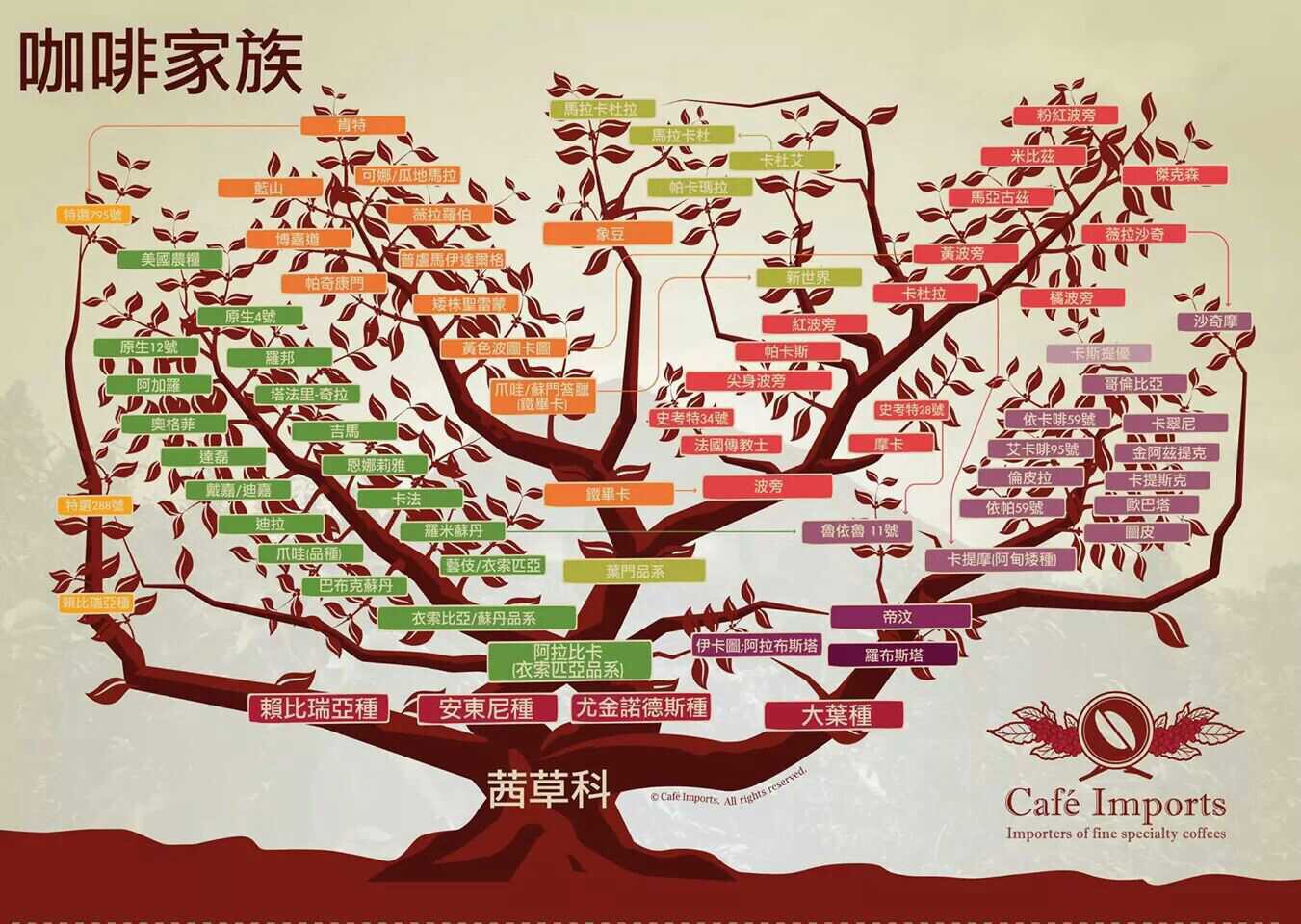
From Ethiopia all the way to East Africa, coffee varieties underwent about 1,300 years of development and evolution. They passed through Yemen, India, Java, the Netherlands, Paris, Bourbon Island, Martinique, Haiti, Mexico, Brazil, and other countries in Central and South America.
Common coffee tree species are mainly divided into two major categories, Arabica and Robusta. Under them there are also very many smaller types, so we do not say that a certain coffee is an Arabica or Robusta bean, but introduce it by the more finely divided coffee bean variety.
ArabicaArabica
All the high-quality coffee in the world comes from the Arabica species, accounting for about 70% of global coffee production. Its flavor is rich, with fine acidity and floral aroma, but its growing conditions are demanding: it needs to be planted in high-altitude areas, grows relatively slowly, and is highly susceptible to pests and diseases.
RobustaRobusta
Robusta is mostly planted in low-altitude areas, has low requirements for the natural growing environment, yields twice as much as Arabica trees, is easy to grow, and has very strong resistance to pests and diseases. Because Robusta’s chlorogenic acid and trigonelline (the sources of bitterness in coffee) contents are both twice those of Arabica, and its caffeine content is also higher, its flavor is naturally bitter and astringent. It is mostly not drunk on its own; it is the main raw material of instant coffee, and some espresso coffees also blend a certain proportion of Robusta to produce better espresso crema.
Arabica coffee bean varieties you must remember
(The coffee bean varieties introduced below all belong to the Arabica category and will be indicated on the coffee bean packaging you purchase.)
01 Typica Typica
Someone once said, “The delicious and noble coffees are all Typica.” Although this saying is somewhat exaggerated, the king of coffee for decades, Jamaica Blue Mountain, is indeed of the Typica variety.
Typica is one of the oldest coffee varieties, growing at relatively high altitudes. Over the centuries it has given rise to many other varieties, including Bourbon, Java, and Maragogype. Typica has low yield and is extremely susceptible to leaf rust. If the delicate Typica is planted properly, it has high sweetness, a clean mouthfeel, and pleasant acidity.
02 Bourbon Bourbon
Bourbon originated from a natural mutation of Typica. Its yield is somewhat higher than Typica, and it is another ancient coffee variety besides Typica. It has high quality and medium yield. Similar to its parent Typica, Bourbon has weak resistance to leaf rust; because of its high sweetness, it is also a favorite food of coffee borers. It has the highest planting rate in Brazil and is also distributed in Burundi and Rwanda. Bourbon fruit is short and round, with high density of pulp and seeds, and usually tastes high in sweetness with bright acidity. Bourbon is divided into Yellow Bourbon and Red Bourbon; in recent years Pink Bourbon can also be bought on the market.
03 Ethiopian Heirloom Heirloom
“Rose, fresh strawberry aroma, and flavors of passion fruit, pineapple, and white wine”
This is used to describe the “Huakui” that became hugely popular this summer. However, “Huakui” is not the name of a bean variety; its true variety is Ethiopian Heirloom. If you see “Heirloom” on coffee bean packaging, it refers to Ethiopian heirloom varieties. Ethiopia’s Kaffa forest is the gene bank of coffee and a treasure trove rich for the specialty coffee world; most bean varieties within Ethiopia originate from the Kaffa forest. Ethiopian heirloom beans are not as attractive in appearance as Bourbon, being smaller in size with uneven bean sizes, but the floral and fruity aroma of the coffee is always stunning.
04 Mundo Novo Mundo Novo
Mundo Novo is a natural hybrid of Red Bourbon and Sumatra Typica, especially popular in Brazil and other places, accounting for 40% of Brazil’s total Arabica coffee planting. Mundo Novo is a higher-yield variety, 30%-40% higher than ordinary Bourbon, and has strong disease resistance. Due to its higher yield per plant, its sweetness is usually lower.
05 Caturra Caturra
A single-gene mutation of Bourbon, discovered in Brazil in the 1950s. Both productivity and disease resistance are better than Bourbon, and Caturra is most common in Central America. However, the tree is shorter, making harvesting convenient; unfortunately, like Bourbon, it has a cycle of fluctuating production every two years. Its flavor is comparable to or slightly worse than Bourbon beans, but more importantly, its adaptability is super strong: it does not need shade trees and can thrive even under direct blazing sun, commonly known as Sun Coffee. At the same time, Caturra can adapt to high-density planting, but requires more fertilizer, increasing costs. Some in academia call Caturra the intensive and sun-exposed version of Bourbon, which is quite to the point.
06 Catuai Catuai
A hybrid of Mundo Novo and Caturra.
The plant is relatively short, and the angle between lateral branches and the main branch is small. In addition to higher yield, the coffee cherries do not easily fall off after ripening, and its strong resistance to wind and rain is another outstanding advantage of this variety. It is favored in windy and rainy producing regions.
Catuai can adapt well at various altitudes, and when planted above 800m it tastes even better. The fruit color is commonly red and yellow, and they are also called Red Catuai and Yellow Catuai respectively.
Catuai is widely planted in many Central and South American producing regions, including Brazil. Catuai also has red-fruit and yellow-fruit distinctions; red fruit more often wins awards than yellow fruit. Mundo Novo, Bourbon, Caturra, and Catuai are together listed as Brazil’s four main coffee varieties.
07 Gesha/Geisha Gesha/Geisha
“I finally saw the face of God in a coffee cup!”?
These were the astonished words of the famous American coffee taster Don Holly after first tasting Gesha’s citrus aroma, honeyed flavor, and floral charm.
With its lovely English name and Chinese translation, Gesha is undeniably a variety that has overpowered veteran coffee powers Jamaica Blue Mountain and Hawaii Kona. It is actually also one of Ethiopia’s heirloom varieties, first discovered in Ethiopia and eventually making its way to Panama. Perhaps the local climate and soil nourished it. The Hacienda La Esmeralda family found in cupping that one lot had a brighter, richer mouthfeel with plant-like floral flavor than other lots, and later searched among the LOTs from which that batch came, finding a Gesha coffee tree whose appearance differed from the nearby coffee trees at the time. The coffee beans from this tree were picked and processed separately, and after competing, it took first place in one go. In recent years its popularity has not diminished; this year’s naturally processed Gesha in the Best of Panama specialty coffee auction even fetched a super-high price of $601 per pound.
8 SL28/ SL34
Although they may not have as much history or as beautiful names as other coffee bean varieties, SL28 and SL34, direct Bourbon-line descendants created in the laboratory by British and French experimenters, are Kenya’s ace bean varieties denoted by these numbers, and coffee gourmets who love acidity cannot help but reach for their wallets as soon as they see them. Kenya’s unique soil with high phosphoric acid content is rumored to be the behind-the-scenes contributor to the bright berry-like acidity that is a major characteristic of Kenyan coffee.
9 Pacamara Pacamara
“Full-bodied flavor, rich and varied, with fruity acidity and intense sweetness coexisting, and carrying multiple variations such as apricot, vanilla, tropical fruit, chocolate, and spice sweetness.”——The aroma and flavor of Pacamara
Pacamara is a cross between the giant bean variety Maragogype and the Pacas variety. Pacamara’s path to growth was not so smooth. Around 1990, Eduardo, the owner of the Pacamara estate in El Salvador, decided to plant Pacamara, a new strain just developed by El Salvador’s agricultural science and technology unit, but because of its huge size, local processing plants did not have suitable pulping and separation machines, and most processing plants were unwilling to process this troublesome new variety.
It was not until 2007, when it won second place in El Salvador’s COE, and then under cultivation at the neighboring country Guatemala’s El Injerto estate it held the top spot and refused to yield, that the world gradually acknowledged it as another bean variety after Gesha that could share the world with Ethiopian heirloom varieties and Typica.
Maragogype (a mutant of Typica, discovered in the Maragogype region of Bahia, Brazil; the Maragogype region produces the world’s largest coffee beans, sometimes called “elephant beans” (do not confuse with the general malformed bean “elephant ear” elephant). Currently planted in Cuba, Colombia, Guatemala, Mexico, and Nicaragua. Because of its mild aroma and attractive appearance, it has become a sought-after coffee bean; due to low yield and high production costs, supply often falls short of demand on the market.)
Liberica (discovered in Liberia in 1843; planting locations: lowlands or flat land below 200m; tolerant of high and low temperatures, and of heavy or scant rain; tree height 10m, leaf shape relatively pointed at the tip and diamond-shaped, petals 8; fruit twice as large as Arabica, with thick pericarp, endocarp, and seed coat; in particular the seed clings tightly to the seed, making removal of the seed coat more laborious, and after ripening it does not easily peel off. Aroma: poor aroma, relatively strong bitterness; strong disease resistance, tolerance, and adaptability; often used as rootstock for Arabica original species. Lowest planting density; main producing areas Liberia, Suriname, Guyana, India, Indonesia, Angola, Côte d’Ivoire, Philippines)
Other cultivated varieties
Arabusta (cuttings)
Hibrido de Timor
Ruiru Eleven, a Kenyan dwarf variety
Timor, a cross between Arabica and Robusta
Catimor (born in Portugal in 1995 as a cross between Caturra and Timor (rust-resistant))
Icatu
Variedad Colombia (a cross between Catimor and Caturra, with 1/4 Robusta lineage)
The following are important Arabica bean varieties
Mocha (planted in Yemen, pulp removed by the natural drying method, named after export from the port of Mocha on the Red Sea!)
Harrar (also called "Ethiopian Mocha", processed directly within Ethiopia’s port area, pulp removed by the natural drying method!)
Blue Mountain (planted in the Blue Mountains of Jamaica)
Kona (planted in Kona, Hawaii)
Sumatra (a natural mutant Typica, planted on the island of Sumatra; the tree appearance is short and stout, with large leaves and large fruit.)
Maragogype (long fruiting period, large leaves and fruit. A new bean variety mutated from Typica.)
Mokka
(from natural mutation, small tree, fruit is a small round bean, planted in Java.)
Caturra (from natural mutation, originated in Brazil.)
Mundo Novo (from natural crossing of Sumatra and Bourbon
Catuai (from artificial crossing of Mundo Novo and Caturra
San Ramon (a dwarf mutant, originated in Central America.)
Ruiru eleven (a dwarf variety selected in Kenya; it has strong resistance to plant berry diseases, but has lost Kenya’s original acidity characteristics!)
Kent (a coffee tree variety cultivated in India; it has strong resistance to plant leaf rust.)
More varieties are welcome to be added and discussed!
Part of the article comes from 【Roast Roast China】
Okay, now let’s start chatting with the members of the Arabica family~ But only some of the main members are introduced here, not all of them!
The two family patriarchs

Typica
“Typica” sounds mighty and impressive, but in fact it is not that strong…… Its constitution is relatively weak, its disease resistance is poor, it is susceptible to leaf rust, and its fruit yield is also low. It is one of Ethiopia’s oldest native varieties, and many Arabicas are derived from Typica!
One of Typica’s characteristics is that its top leaves are bronze-colored. The beans are relatively large, forming a pointed oval or slender pointed shape. Familiar and thunderous names such as Mandheling, Blue Mountain, Maragogype, Kona, Yunnan small round beans…… are all derivative varieties of Typica. (So awesome.)

Bourbon
“Bourbon” is an ancient excellent variety on a par with Typica, and some botanists also believe that Bourbon is a mutation after Typica was transplanted to Yemen in the early period.
Bourbon is almost entirely round beans. The beans are a little smaller than Typica, and it matures later, but its yield is 30% more than Typica. It is suitable for planting above 1,200 meters, and its flavor is clearly more outstanding than below 1,000 meters. But Bourbon has a drawback: after bearing fruit for one year, it must rest for one year. Round-bean Bourbon has vigorous vitality, and its resistance to leaf rust is better than Typica, but its flavor is not inferior to Typica——even better.
In 1810, some round beans on Bourbon Island mutated into pointed beans. This is the famous “Pointed Bourbon.” Its characteristic is that its caffeine content is only half, its yield is low, and its constitution is weak. It is extremely rare, like a frail noble pretty boy……
In addition, the biggest thing Typica and Bourbon have in common is that both need the protection of shade trees. If there are no shade trees to block the blazing sun for them, it is not only unfavorable to their growth, but the flavor of the coffee beans produced is also greatly reduced.
Genetic mutants
Variants of the Bourbon family
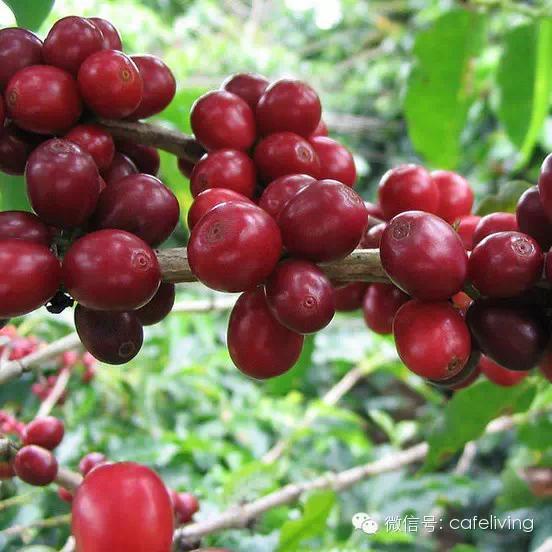
Kenya
“SL28” and “SL24” are direct Bourbon-line varieties selected and cultivated in Kenya in the early 20th century by French and British missionaries and researchers. Over the past century it has adapted to Kenya’s soil with high phosphoric acid concentration, and the Kenyan beans it produces have a special acidic aroma and spirit, different from Central and South American Bourbon beans. But after being transplanted to Asia, it lost its flavor and could not show its characteristics.

Yellow Bourbon
“Bourbon Amarello” Yellow Bourbon is a yellow-skinned Bourbon variant unique to São Paulo State, Brazil. Generally coffee cherries turn red when ripe, but Yellow Bourbon does not turn red after ripening; it is orange-yellow, hence the name. Because Yellow Bourbon has taken almost all the top three awards in the “CoE” (Cup of Excellence), it has become the hot favorite of the specialty coffee world.
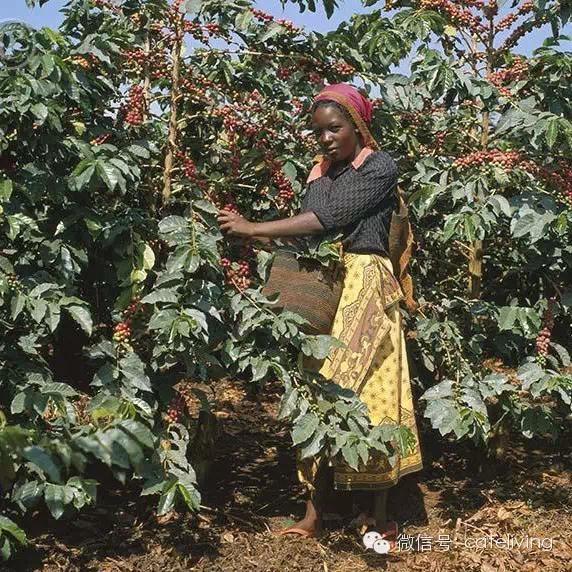
Caturra
“Caturra” is a single-gene mutation of Bourbon discovered in Brazil in the 1950s. Its productivity and disease resistance are both better than Bourbon. The tree is shorter, making harvesting convenient. Unfortunately, it encountered the same problem as Bourbon——bearing fruit one year and resting the next. Its flavor is comparable to or slightly worse than Bourbon beans.
But its adaptability is stronger: it can be planted at high density, does not need shade trees, and can thrive even under direct blazing sun, so it also has a name——“Sun Coffee.”
Caturra is suitable for low altitudes of 700 meters up to high altitudes of 1,700 meters, but the higher the altitude, the better the flavor, and the bean yield relatively decreases. There is also a yellow Caturra variant in Central and South America, but its reputation is not as good as Yellow Bourbon.
Pacas
“Pacas” In 1935, Salvadoran coffee farmer “Don Alberto Pacas” selected high-yield San Ramon Bourbon varieties and moved them to his estate for planting. In 1956, his coffee trees bore more fruit than coffee trees of the same type. University of Florida professor “Dr. William Cogwill” determined that this was a genetic mutation of Bourbon and named it “Pacas.”
Pacas has high yield and good quality and is quite popular in Central America. Currently 68% of El Salvador’s coffee is Bourbon varieties, and Pacas accounts for 29%.
Variants of the Typica family

Maragogype
“Maragogype” was discovered in 1870 AD in the “Maragogype” producing region of “Bahia” in northeastern Brazil. Because its bean body is at least three times larger than ordinary Arabica, the largest in the world, it got its name. It is the most famous mutant bean of Typica and the giant baby of the Typica family.
Maragogype adapts well to low-altitude areas of 700m—800m, but its flavor is lackluster, without any special characteristics, and it even has an earthy smell. Therefore, it is better to choose areas above 1,000 meters, where the flavor is better, the acidity mild, and the sweet aroma pleasant.

Kona
“Kona” although planted at an altitude of several hundred meters, Kona from the Big Island of Hawaii, blown by gentle sea breezes and combined with fertile volcanic rock soil, has an incomparably clean acidity and sweetness. Compared with the higher-altitude Blue Mountain, it is simply even better.
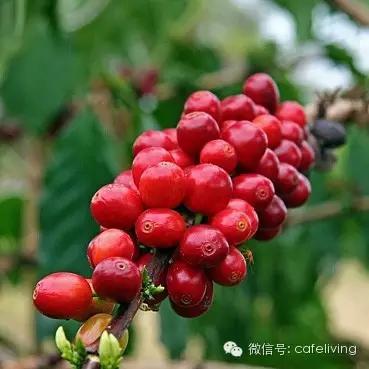
Blue Mountain
“BlueMountain” is popular worldwide, and Blue Mountain, for which even a single bean is hard to find, comes from the great Typica family. Why is Blue Mountain so expensive?! Mostly because it is largely contracted by the Japanese, and another reason is that once it leaves Jamaica, it does not adapt and performs poorly. After two hundred years of domestication, Blue Mountain has finally evolved successfully in Jamaica, and its resistance to rotten fruit disease is better than ordinary Typica. Where can Blue Mountain be tamed next? We can look forward to it~
Hybrids of the two great families
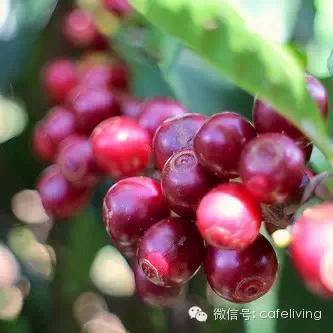
Mundo Novo
“Mundo novo” Bourbon and Typica had an illicit affair! The two great families produced an illegitimate child! It was first discovered in Brazil, with high yield and strong disease resistance. The only shortcoming is that its tree can grow over 3 meters tall, making harvesting difficult. Because of its good cupping quality, it is hailed as the new hope of Brazil’s coffee industry, hence the name Mundo Novo.

Catuai
“Catuai” is a hybrid of Mundo Novo and Caturra, a second-generation hybrid, so to speak. It inherited Caturra’s advantage of a low trunk and also made up for Arabica’s weakness of fragile fruit. The fruit sets firmly and does not easily fall off when strong winds blow. The greatest regret is that its overall flavor is slightly more monotonous than Caturra.
Catuai also has red-fruit and yellow-fruit distinctions; red fruit more often wins awards than yellow fruit. Catuai, Caturra, Mundo Novo, and Bourbon are together listed as Brazil’s four main coffee varieties.
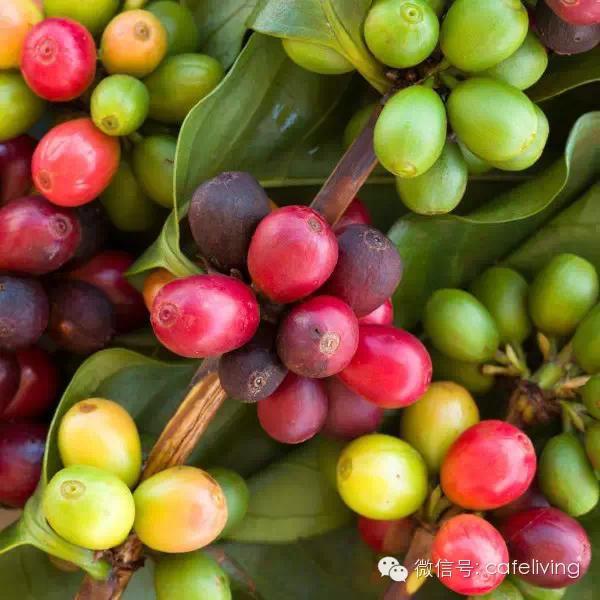
Pacamara
“Pacamara” is the crystallization of the Typica mutant Maragogype and the Bourbon mutant Pacas, another hybrid. Its bean size is second only to Maragogype. In 2007 it won the “CoE” double championship in Guatemala and Honduras, and also swept the top three awards in El Salvador. It is a rising star of El Salvador.
Illegitimate children with Robusta
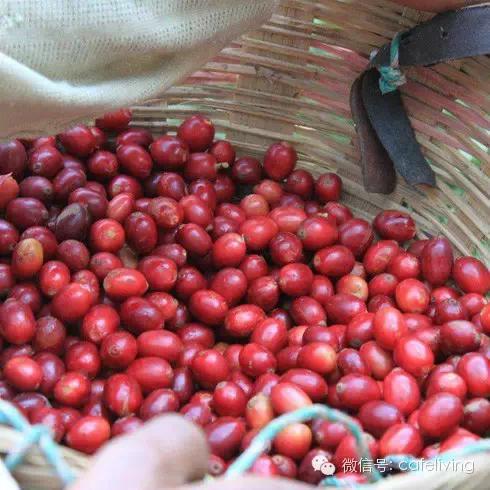
Timor
“Timor” On the island nation at the eastern end of the Lesser Sunda Islands——East Timor, a child of Arabica and Robusta was discovered (ah, you actually……)——Timor, which is closer to Arabica. Timor has low acidity and lacks distinctive features; Taiwan often uses it in blend beans to lower costs. Alas, such is the importance of genes……
But East Timor also has high-altitude purebred Typica processed by washing. Before purchasing, be sure to clarify whether it is a hybrid or purebred washed Typica. The quality of the two differs greatly: the former is plain and ordinary, while the latter is stunning.

Catimor
“Catimor” In 1959, the Portuguese moved the Bourbon variant Caturra to East Timor and crossed it with Timor, which carried Robusta lineage, cultivating the second-generation hybrid Catimor, whose disease resistance and yield capacity are both super strong.
Although Catimor inherited Robusta’s sturdy advantages, it also inherited its poor-flavor genes. In order to improve Catimor’s poor cupping reputation, in recent years botanists in various countries have turned back to cross Arabica with Catimor multiple times, trying to reduce the Robusta lineage.
Icatu
“Icatu” In the past, Arabusta, a cross of Arabica and Robusta, improved yield and disease resistance, but the coffee flavor remained poor. Scientists then crossed Arabusta with Arabica varieties such as Caturra, Mundo Novo, and Bourbon over multiple generations, gradually reducing the unpleasant flavor of Robusta and improving the aromatic richness of Arabica beans, thereby creating the excellent multi-generation hybrid——Icatu.
In addition, other hybrids of Arabica and Robusta include “Ruiru 11,” “Chandragiri,” and so on. Generally speaking, they all inherited Robusta’s sturdy disease resistance but weakened Arabica’s flavor. For coffee lovers, whether these hybrids can ultimately perform satisfactorily still awaits further cultivation and testing!

This article aims to help coffee newcomers briefly understand the variety classification of Arabica and should not be used as a rigorous botanical classification reference.

Light Roast Pour-Over Floral Coffee Beans Recommendation: Qianjie Yirgacheffe Gedeo Dingding, Qianjie Panama Hacienda La Esmeralda Green Label Geisha Coffee Beans, QianjiePanama Butterfly Coffee Beans
Daily medium-light roast Yirgacheffe pour-over floral coffee bean recommendation, Qianjie Yirgacheffe Guddina, light roast brings the signature white floral notesAromatic, with lemon-citrus fruit notes and a refreshing floral tea note; bright and crisp on the palate. Great value and an ideal entry-level pour-over coffee with floral and fruity notesAn unrivalled choice.
Moka pot, home espresso, and espresso-based milk drinks like latte — recommended beans: Qianjie Classic Espresso Blend, using BrazilianWest, with Mandheling Arabica and a small amount of Vietnamese Robusta fully blended, delivering a rich and outstanding espressocrema; overall style is rich and memorable. Qianjie Brazil Queen's Estate coffee beans and Qianjie Classic Espresso Blend coffee beans are both mochaA highly recommended option for pot-style espresso machines.
Fruity-floral signature espresso latte bean recommendation: Qianjie Strawberry Candy espresso blend, featuring strawberry gummy and rose aromas,Full-bodied sweetness with a grape and almond finish; especially stunning as an iced latte. Made from Costa Rican honey-process beans, PanamaBlended from Panama Geisha coffee beans and select beans from Colombia's Huila region. Not only does it overturn traditional espresso flavor, the cremaalso performs well, with impressive showings in creative specialty drinks.
Now available on Taobao store「 Qianjie Coffee 」To purchase the above coffee beans, Qianjie Coffee offers dozens of selected single-origin pour-over and espresso coffee beans from around the world. Qianjie CoffeeQianjie Coffee is a veteran specialty coffee roaster; beans are freshly roasted within 5 days, with consistent quality and highly competitive pricesGreat value, ships within 24 hours. Qianjie Coffee is recommended by many coffee lovers and platforms.
Taobao Qianjie Coffee Link:https://qianjiecoffee.taobao.com
Or search our shop directly on Taobao 「Qianjie Coffee」
Qianjie Coffee Store Address: 315 Donghuadong Road, Yuexiu District, Guangzhou

Site Recommendations: 耶加雪菲 花魁咖啡 瑰夏咖啡 波旁咖啡 蓝山咖啡 天堂鸟咖啡豆 曼特宁咖啡豆 PWN黄金曼特宁 星巴克菜单 咖啡豆种类
Please indicate the source when reprinting.
2021-10-13 05:39:40
