The Geisha variety was first collected from the coffee forests of Ethiopia in the 1930s, then passed through a research station in Tanzania, and was brought to a research institution in Costa Rica in 1953. Today, coffee labeled "Geisha" can be found everywhere, and the distinction between Gold Label and Red Label is precisely the market-side continuation of this history of dissemination.

For more specialty coffee knowledge, please follow: Front Street Coffee (Frontsteet Coffee)
Geisha has presumably already become a single-origin coffee that many coffee enthusiasts are passionate about, but there are many coffees on the market labeled "Geisha" — so what characteristics does this variety have that make everyone so fascinated by it? Today, Front Street will start from the birthplace of Geisha.
Through researching materials, Front Street has learned that the Geisha variety was first collected from the coffee forests of Ethiopia in the 1930s. From there it was sent to the Lyamungu Research Station in Tanzania, and then in 1953 it was brought to the Centro Agronómico Tropical de Investigación y Enseñanza (CATIE, Tropical Agricultural Research and Higher Education Center) in Costa Rica, but it was recorded as T2722.

After people recognized the variety's tolerance to coffee leaf rust, it was distributed through CATIE to Panama for planting in the 1960s. However, because the branches of this variety's plants are very fragile, it was not favored by farmers, so it was not widely planted. It was not until 2005 that Hacienda La Esmeralda used the Geisha variety to participate in the BOP competition and auction. The exceptionally high score made this bean suddenly famous.
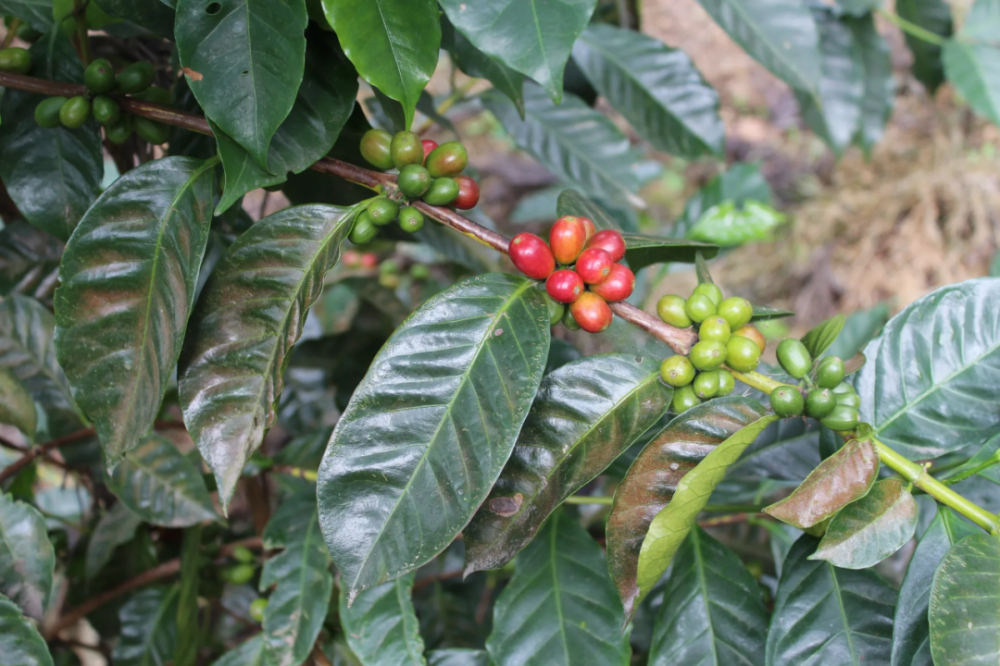
But besides Panama, countries such as Costa Rica and Colombia also grow Geisha. However, when it comes to Geisha, one cannot fail to mention Gesha Village Coffee Estate in Ethiopia.

Gesha Village Coffee Estate
In 2007, director Adam Overton and his photographer wife Adam Samuel, while filming a documentary about Ethiopian coffee for the Ethiopian government, came into contact with the Bench Maji region in the westernmost part of Ethiopia, near South Sudan, and discovered the Gori Gesha Forest there, which gave them the idea of establishing their own coffee estate and brand.


Gesha Village has three varieties: Gesha 1931, Gori Gesha, and Illubabor.
Gesha 1931 (G31) traces the source of Geisha to 1931, when it was collected by the British border from the Geisha forest in Ethiopia, and after several transfers it went to Panama. Later, the native Geisha that Adam Overton and Willem Boot found near the estate was genetically very close to the Panama Geisha variety, so it was named Gesha 1931.
Gori Gesha (GG) was discovered in 2011, after Adam and his wife established Gesha Village Coffee Estate. In the Gori Gesha Forest 12 miles away, they found a bean variety that looked very much like Geisha. Since it was discovered in the Gori Gesha Forest, it was named Gori Gesha.

Illubabor Forest 1974 (IF) was discovered in 1974 during an expedition in the Illubabor Forest, and later the Ethiopian research center developed a variety with resistance from it.
Gesha Village is divided into eight major blocks, and each block grows only one variety, so the variety can be identified by the block. The oma, surma, and narsha blocks grow Gesha 1931; the bangi, shewa-jibabu, and shaya blocks grow Gori Gesha; and finally the gaylee and dimma blocks grow Illubabor.
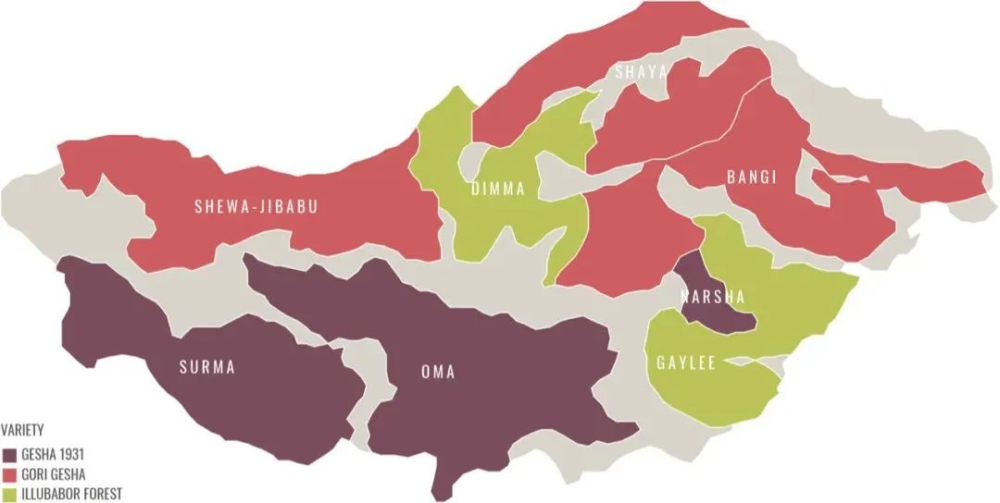
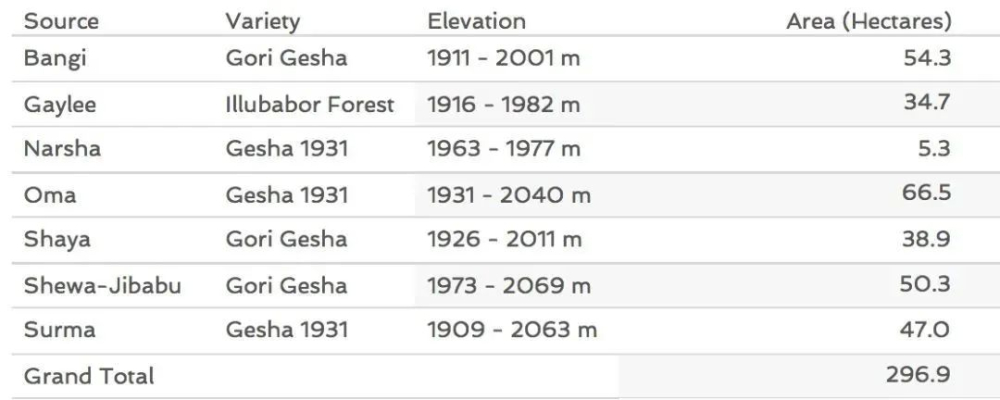
Originally, Ethiopia had almost no large estates. When Adam and his wife started Gesha Village Coffee Estate, they brought the management model of Panama coffee estates to this place. Therefore, Gesha Village Coffee Estate also has detailed block divisions and block numbers, facilitating later management and traceability. In terms of grading, there is an auction lot, accounting for 3.7% of Gesha Village's annual output, which can only be obtained through the global auction of Gesha Village Coffee Estate.

The Gold Label lot is second only to the auction lot, accounting for 5% of the estate's annual output. The Red Label lot is second only to the Gold Label, requires a cupping score above 88, and is also a single-origin lot with relatively high cost performance. There is also a Green Label lot, which only provides traceability information but has no cupping score requirement. Finally, there is also the Chaka lot, which is a Geisha blend using the estate's three Geisha varieties and mixing blocks, namely Gori Gesha, Gesha 1931, and Illubabor.

For Gesha Village coffee, we have respectively obtained Front Street Gesha Village Gold Label Geisha, Front Street Gesha Village Red Label Geisha, and Front Street Gesha Village Chaka, all using natural processing and medium-light roasting. Front Street Gold Label Geisha has obvious chamomile and orange flavors, accompanied by the charm of tangerine pu-erh tea; Front Street Red Label Geisha leans more toward a fresh citrus tone with a rounded mouthfeel; while Front Street Chaka is the most cost-effective single-origin coffee, with soft berry flavors. All three Gesha Village coffees above can be ordered and purchased at the Front Street flagship store and Front Street Taobao store.

Light Roast Pour-Over Floral Coffee Beans Recommendation: Qianjie Yirgacheffe Gedeo Dingding, Qianjie Panama Hacienda La Esmeralda Green Label Geisha Coffee Beans, QianjiePanama Butterfly Coffee Beans
Daily medium-light roast Yirgacheffe pour-over floral coffee bean recommendation, Qianjie Yirgacheffe Guddina, light roast brings the signature white floral notesAromatic, with lemon-citrus fruit notes and a refreshing floral tea note; bright and crisp on the palate. Great value and an ideal entry-level pour-over coffee with floral and fruity notesAn unrivalled choice.
Moka pot, home espresso, and espresso-based milk drinks like latte — recommended beans: Qianjie Classic Espresso Blend, using BrazilianWest, with Mandheling Arabica and a small amount of Vietnamese Robusta fully blended, delivering a rich and outstanding espressocrema; overall style is rich and memorable. Qianjie Brazil Queen's Estate coffee beans and Qianjie Classic Espresso Blend coffee beans are both mochaA highly recommended option for pot-style espresso machines.
Fruity-floral signature espresso latte bean recommendation: Qianjie Strawberry Candy espresso blend, featuring strawberry gummy and rose aromas,Full-bodied sweetness with a grape and almond finish; especially stunning as an iced latte. Made from Costa Rican honey-process beans, PanamaBlended from Panama Geisha coffee beans and select beans from Colombia's Huila region. Not only does it overturn traditional espresso flavor, the cremaalso performs well, with impressive showings in creative specialty drinks.
Now available on Taobao store「 Qianjie Coffee 」To purchase the above coffee beans, Qianjie Coffee offers dozens of selected single-origin pour-over and espresso coffee beans from around the world. Qianjie CoffeeQianjie Coffee is a veteran specialty coffee roaster; beans are freshly roasted within 5 days, with consistent quality and highly competitive pricesGreat value, ships within 24 hours. Qianjie Coffee is recommended by many coffee lovers and platforms.
Taobao Qianjie Coffee Link: https://qianjiecoffee.taobao.com
Or search our shop directly on Taobao 「Qianjie Coffee」
Qianjie Coffee Store Address: 315 Donghuadong Road, Yuexiu District, Guangzhou

Site Recommendations: 耶加雪菲 花魁咖啡 瑰夏咖啡 波旁咖啡 蓝山咖啡 天堂鸟咖啡豆 曼特宁咖啡豆 PWN黄金曼特宁 星巴克菜单 咖啡豆种类
Please indicate the source when reprinting.
2025-11-20 09:06:20
